
In this post, I explain why I volunteer to give guest lectures for students and what supporting the next generation of developers, architects and engineers means to me.
Introduction
Opening LinkedIn one morning in June 2026, I was deeply touched to receive these kind and unexpected words from Ada‘s Steve Rich after my recent trip to sunny Sheffield:

I wasn’t initially sure how to respond without it turning into LinkedIn farming or a self-congratulatory fest, so writing about it here felt like the best option. I recently wrote some tips for anxious new panellists, and in a similar spirit this post seems like the best way to explain why I give these lectures and why I think they’re important.
Sure – it’s a good opportunity for me to practise and get out of my comfort zone. And as an AWS Community Builder and User Group Leader, I have access to tools and services that help me share knowledge and connect with the wider tech community. But there’s more to it than that, going back to my own experience studying technology in the early 2000s and why that motivates me to support today’s up-and-comers.
So in this post, I’ll talk about how I try to close the gap between the classroom and the real world. I’ll walk through what I did in Sheffield, and explain why supporting the next generation matters, both for Ada students and beyond.
About Ada
Firstly, some context about Ada:

Ada, the National College for Digital Skills, is a specialist further education college founded in 2015 and named after Ada Lovelace. They offer Sixth Form and Apprenticeship curricula, have campuses in London and Manchester and also operate a cohort in Sheffield. Ada works with employers including AutoTrader, HSBC and Siemens, aiming to transform the lives of 10,000 young people by 2028.
Starting in 2024, I’ve done four lectures for Ada covering topics including cloud computing, data analytics and my career journey. What began as stepping outside my comfort zone has become a semi-regular thing! As someone active in the wider AWS community, through AWS User Group Lancashire and beyond, I’m hopeful I’ll get similar opportunities with Ada and other colleges and universities in the months and years ahead. I feel that supporting the next generation, wherever I can, aligns closely with the goals of the Community Builder and User Group Leader programs.
Making It Real
Let’s rewind to the early 2000s when I was studying. Studying technology was very different then than it is today. There was no Stack Overflow to read and interact with, no YouTube lectures and tutorials to watch and no Discord servers to share ideas and pool experience.
Instead, there were textbooks, demo files, PowerPoint slides and internet forums of varying quality. And despite my best efforts, my attention and enthusiasm slowly drained. I couldn’t see how I would use what I was learning in the real world. It wasn’t real, and I couldn’t find a way to make it real.
These were entirely my issues. Others I was studying with at the time went on to great things, but we don’t all learn in the same way, and that’s just how things panned out.
Fast forward twenty years, and that gap has closed in one sense. Today’s students have resources I couldn’t have imagined. But having more resources doesn’t necessarily solve the problem. What’s still missing is context: how all this stuff actually gets used, day to day, by people doing the job. That’s the gap I try to fill with my lectures – my own attempt at supporting the next generation to help them reach and thrive in the tech industry.
Opening It Up
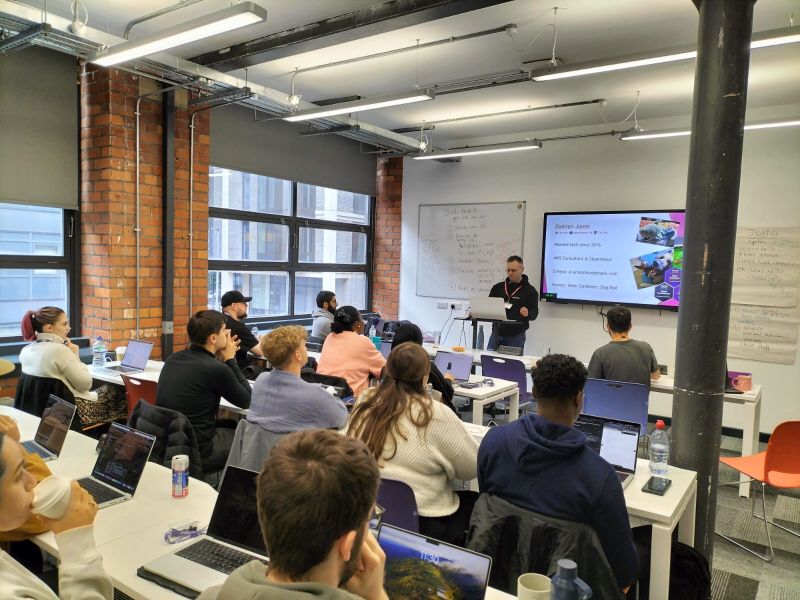
The recent lecture I delivered for Ada in Sheffield is a good example of the kind of things I like to do. After getting a brief from Steve on what the students were studying, I built a simple real-time voting web app for the lecture. To make it interesting, the app used a shared frontend and database, but split its backend across three different AWS compute services – EC2, ECS, and Lambda – each with its own endpoint:

My lecture had three parts. I began by discussing some core cloud concepts they’d touched on in class and which would soon come into play:
- AWS Regions: Explaining what they are and how they address real-world concerns such as service latency, HADR and data sovereignty.
- AWS Services: Exploring some of the service categories and explaining why AWS offer several services within each category.
- Manual vs Managed: Discussing why managed services exist and exploring some of the high-level benefits and tradeoffs.
Then, I loaded up the app and let the students try it during a break.
In the second part, I broke the app down into its constituent pieces. I showed the architecture diagram and the CDK code, then accessed my AWS account and walked through everything: the shared CloudFront frontend and S3 storage, the different compute setups and even the Cost Explorer charts and CloudFormation deployment timelines.
This is something I rarely get to do in public, since most of my diagrams and code are subject to NDAs! This app was different – a bespoke build funded by my AWS Community Builder credits with nothing stopping me from opening it up to my audience completely. For the students, that meant a real AWS bill, a real deployment pipeline and real architecture decisions, not a sanitised slide-based classroom example.
The final part opened the floor for questions about the app, my Steamhaus role and anything else on their minds.
Making It Stick
I approach these lectures the same way I approach creating my AWS community sessions. Diagrams and slides will always have their place, but I prefer showing people what things actually do. When students can see a system working in the real world, it sticks in a way slides rarely do.
It’s also, in a small way, me helping these students with something I found hard while studying myself. I didn’t get any real-world examples, so I had to make do with what I could find and struggled as a result. If I can now reduce that burden for someone else, even by a lecture’s worth, that is time well spent.
Lectures like this aren’t easy to prepare, and they don’t always go to plan. But that’s kinda the point! Sometimes, neither does the job!

Making It Accessible
When I was studying, there was always a question in the back of my mind that I couldn’t quite answer. What are the jobs like? What are the people like? What’s a typical day?
Without access to industry professionals it was impossible to know, and it’s easy to fill in those gaps with assumptions. And when your only experience of technology is via academia, you end up assuming the industry is full of academics.
The reality is very different. Yes, there are deep specialists who have been doing this all their lives. But there are also new starters, generalists, career-changers and everyone in between. This isn’t as obvious from the outside as it seems, so I try to improve the tech industry’s accessibility for students in two ways:
- Bridging the gap between Levels 100 and 200.
- Showing students that the people already doing the job are just as human as they are.
Levelling Up
Firstly, let’s talk about AWS levels. AWS uses a five-level scale to grade the audience knowledge expected of its talks, training and documentation. This ranges from Level 100 (Foundational) to Level 500 (Distinguished). It’s meant to help people find content pitched at the right depth for them, and help speakers and writers scope their material to a specific audience.

I’ve long held the opinion that there’s a missing layer between Levels 100 and 200 – and that’s where most students sit. There’s no exact science here, so I’ll use the AWS Community Day DACH Talk Levelling Guide for reference. It defines Level 100 audience knowledge as someone who might have heard of AWS but has little or no hands-on experience with it. Level 200 steps up to familiarity with the basics: spinning up resources and knowing core terms like VPC, EC2 and S3.
But going from not using AWS at all to spinning up AWS resources, and going from having limited knowledge of the public cloud to understanding the differences among networking, compute and storage services, are big leaps!
For example, students may be aware of AWS Regions but not understand their importance or utility. That understanding only really comes with real-world experience, and these students haven’t had the chance to build that yet. So a Level 100 session might teach them nothing new, while a Level 200 session might go over their heads.
I try to pitch my student lectures somewhere between. Expanding on the Level 100 fundamentals without assuming familiarity with Level 200 topics like containerisation, storage types and network subnets. It’s a tricky balance, and I don’t always get it right! But I aim to help them understand how services slot together for the kinds of things they’ll be doing in their careers. This understanding will, over time, help them manage resources and make their own architectural decisions, ultimately unlocking the myriad Level 200 and Level 300 materials that are widely available.
Keeping It Human
In our industry, there’s no always-right answer, and no answer without compromises or tradeoffs. I’m not a polished, gatekept authority handing down absolute truths. I’m just an engineer making things work.
This is why I prefer using an informal conversational style over a scripted, flawless “Here’s the correct solution” one. At Sheffield, I demonstrated the voting app in the same way I’d explain it to a colleague over coffee – mistakes, tangents and all.
Ultimately, if the students can see that this bumbling, slightly chaotic shark can make a half-decent go of things in the tech industry, then they should be emboldened enough to have a go themselves. To me, that’s what supporting the next generation is really about.
Paying It Forward
Like many within the tech industry, my career is built on the generosity and patience of colleagues and strangers. Without these people, I wouldn’t be in the position I am today. I still remember the growing pains associated with triaging a ticket, using a Python virtual environment and being shown how to exit Vi for the first time. And the second time. And the thir…, well – you get the idea.
Looking back, the best seniors I worked with understood that mentoring isn’t a one-way street. When you guide someone, it builds momentum that helps them, and helps you too:
- The learner gains confidence: They start taking initiative and solving problems independently.
- The load gets shared: As they build confidence, they can take on operational workloads and build real, hands-on experience.
- Your own knowledge gets stress-tested: You arguably don’t truly understand a concept until you have to explain it to someone else.
- You grow as a leader: Teaching forces you to refine your communication, empathy and patience.
These principles also apply to lectures like the one in Sheffield. It’s not just information flowing one way from me to the students, but something that sharpens my own thinking too – supporting the next generation and myself at the same time.
The idea of paying it forward is central to our industry, whether from a screen, at a desk or in a classroom. There will always be people with experience to pass on, and people with things to learn. Now I’m in a position to pay it forward myself, handing on knowledge that took me decades to gather. So I’ll do what I can to keep this industry flywheel spinning.

Summary
Twenty years ago, I didn’t have access to people working in the tech industry, and it would have made a real difference in the years that followed. Now that I’m in a position to be that person for someone else, I think it’s vitally important to make time for that.
Beyond the people I meet at conferences, meetups and user group events, there are entire generations of future developers, architects and engineers in classrooms around the world. And they’re all wondering what the industry holds for them. At a time of hiring uncertainty and AI-driven upheaval within the tech industry, supporting the next generation with honest, hard-earned advice is more necessary than ever.
Steve’s message is a good reminder of why all this is worth doing. If I don’t do it, who will? And if I do it often enough, and visibly enough, I’ll hopefully encourage others to do the same.
Like this post? Click the button below for links to contact, socials, projects and sessions:

Thanks for reading ~~^~~