Categories
Training & Community

Three Mantras For The Anxious New Speaker

In this post, I share three mantras for the anxious new speaker and some helpful resources for session development that I’ve used this year.

Introduction

This year has been a whirlwind! After presenting my first in-person session at AWS Community Summit London in April, I’ve since spoken at user groups, a paid event and even internationally!

This hasn’t come easy for someone as naturally anxious as me. I work procedurally in many areas, which doesn’t lend itself fully to organic and spontaneous pursuits like public speaking.

I use mantras during exercise when I need quick guidance that’s easy to recall, and after London I realised that a similar approach while speaking would calm my nerves and refocus my attention. These mantras have since become invaluable, so now I’ll present them here.

Firstly, I’ll share three mantras that have guided me through developing, presenting, and evaluating my sessions. Following this, I’ll add some helpful resources for session creation, slide deck development and delivery mindset.

Mantras

This section contains three mantras for the anxious new speaker that I’ve used this year.

No One Wants You To Fail

I begin with some imposter syndrome goodness. Public speaking offers rich ammunition for imposter syndrome sufferers, like:

  • “The audience will be full of experts and I don’t belong in front of them.”
  • “No one will enjoy my session or find it useful.”
  • “No one will take me seriously.”

But the reality is very different. Audiences want speakers to succeed because it creates a more enjoyable and informative event, fostering better knowledge sharing and a positive atmosphere.

And it’s not like the session’s content is a secret! Consider delivering a session to a user group. The session’s abstract has likely been seen by a user group leader and several audience members before the doors even open. People know what they are getting into and are choosing to be there!

Audiences want to enjoy and benefit from the session, and they’re often patient, understanding, and forgiving when things don’t go perfectly. They’re not there to criticise or judge – they’re hoping the speaker succeeds and provides value.
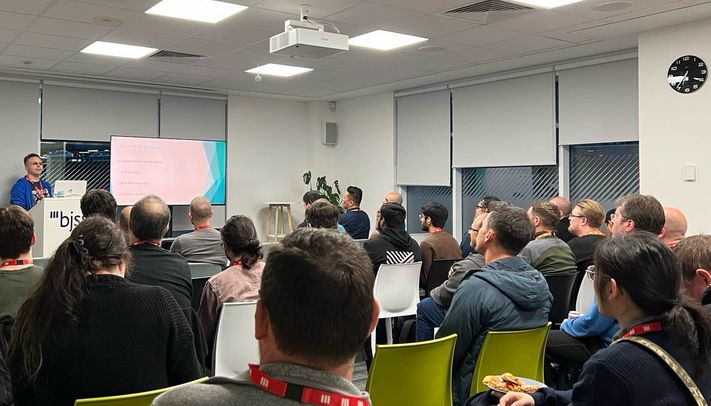
AWSUGLeeds

People Are Watching The Slides, Not You

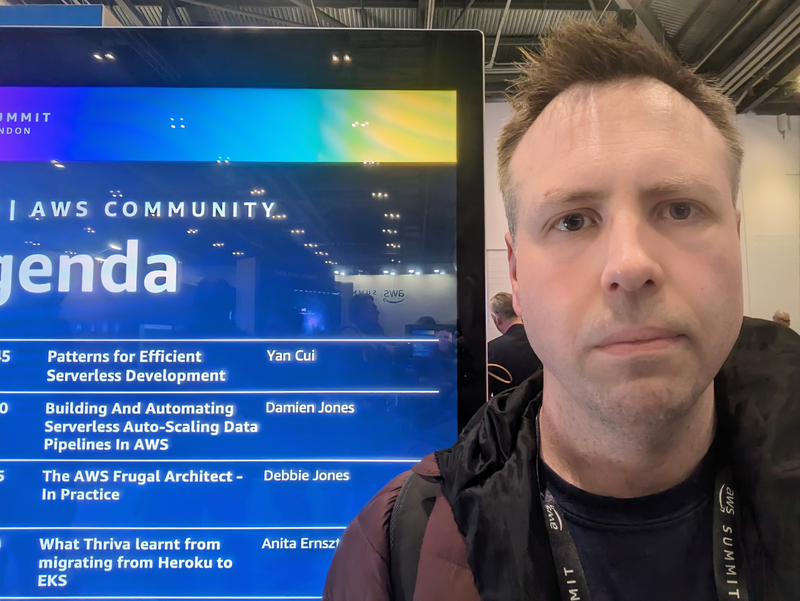
Flashback to April 2024 – my first in-person session at AWS Summit London. I was presenting midway through the day, and my anxiety brain entered high gear while waiting:

  • How should I stand?
  • What should I do with my hands?
  • How often should I look at the audience?
  • OMGOMGOMG

Anxiety brain then fixated on the various keynotes and TED Talks I’ve seen instead of focusing on my session. Great.

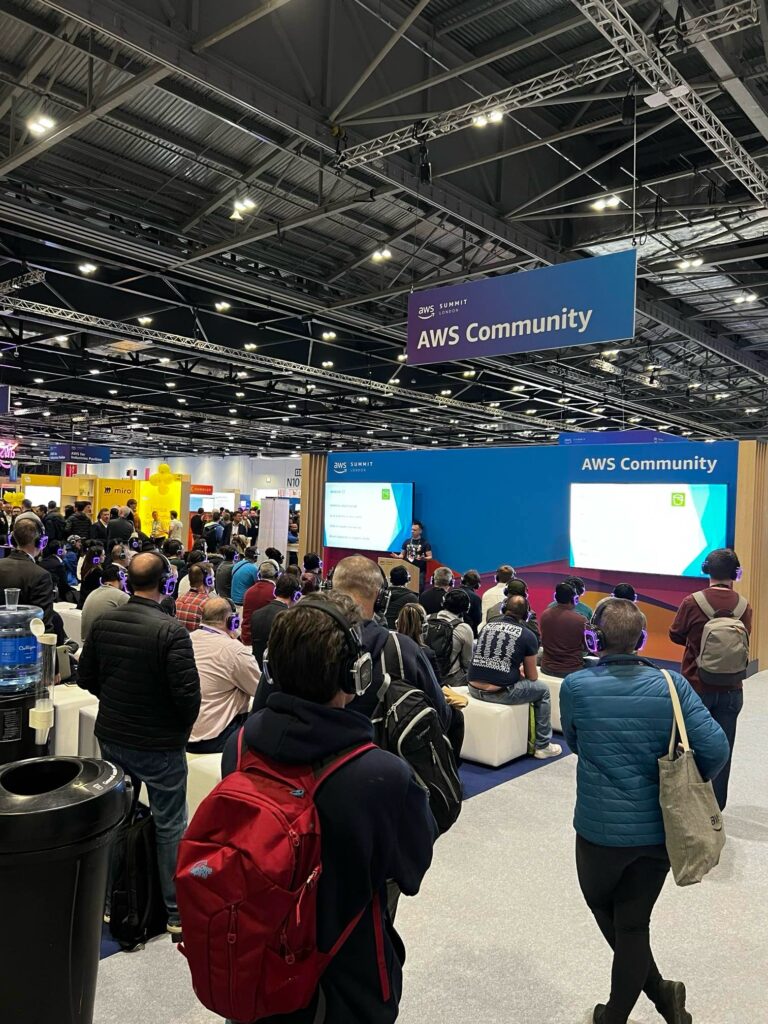
Then I had an idea. I started watching the audience. Some people were checking their lanyards and swag bags. Others were glancing at the passing crowds or grabbing a coffee from the nearby Serverlesspresso stand. But most were fully focused on the slides.

No one was fixated on the speaker.

Next, I watched the speaker. They looked up and down, occasionally gesturing. Nothing about their delivery felt like a finely choreographed routine.

In those moments, I realised that I was holding myself to impossibly high standards for my first in-person session. This wasn’t reality TV or theatre. This was a group of enthusiasts with common interests seeking knowledge. The audience wasn’t here to watch me. They were here to watch the slides.

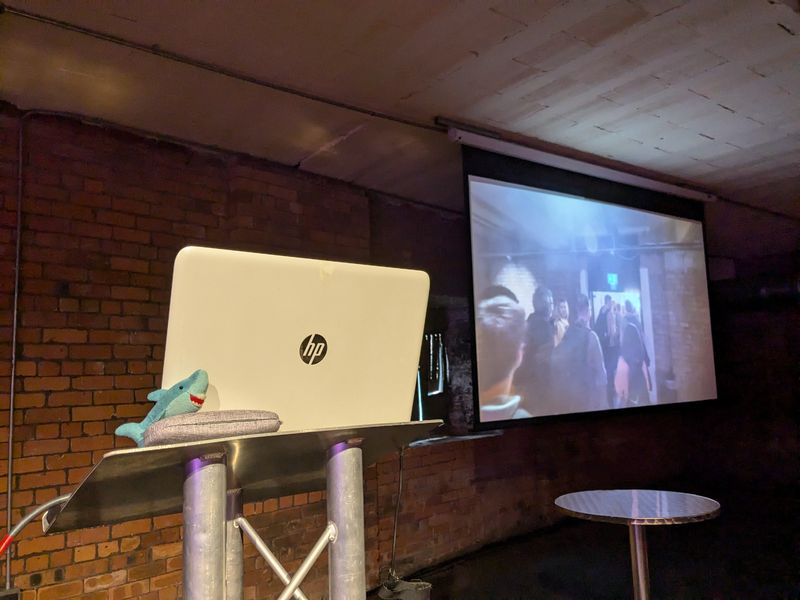
That shift in perspective helped me so much. Without that mantra in April, there’s no way I would have been capable of doing Comsum (a filmed session in front of a paying audience) in September:

Every Minute Is A Victory

I said I use mantras during exercise earlier, and this one is pretty much a straight rip from those. Being a speaker (especially an anxious new speaker!) demands time and energy for tasks like:

  • Developing an abstract, submitting it to a user group or call for papers and awaiting the outcome.
  • Curating and preparing a session, updating and refining a slide deck and practising delivery.
  • Making sure you’re in the right place, at the right time with the right materials. And waiting for the day to arrive!
  • Delivering the session, maintaining flow and addressing audience questions.
  • Evaluating the session, tweaking the content and reflecting personally on the experience.

It would be easy to look at all this, nope out and spend your time elsewhere. So every minute spent on a session, from inception to post-delivery, is a victory.
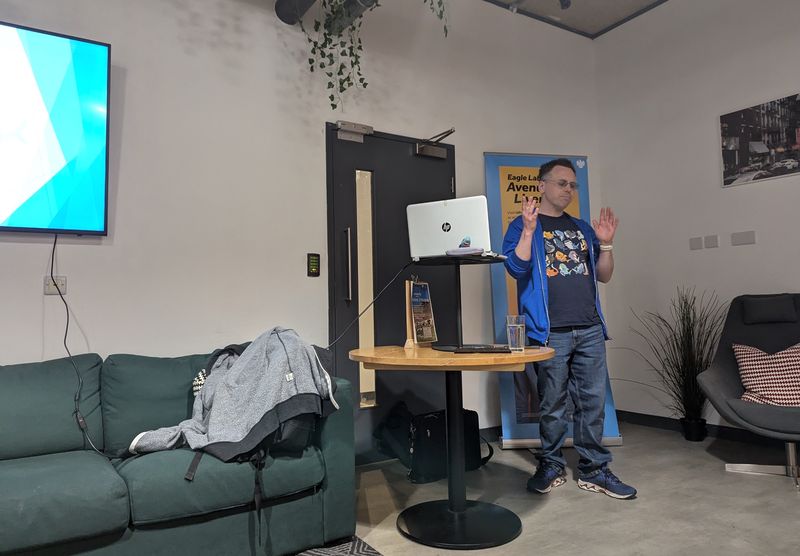
AWSUGLiverpool

Resources

This section contains some helpful resources for session development.

New Stars Of Data Library

New Stars of Data is an event dedicated to mentoring and promoting new speakers in the Microsoft community. It is run by Ben Weissman and William Durkin, and is supported by a team of experienced speakers. I participated in NSOD6 in 2023.

New Stars Of Data has a Speaker Improvement Library supported by the Microsoft Azure Data Community. This library was invaluable during my New Stars of Data journey, and I still refer to it regularly for guidance and inspiration.

Here are some of my personal favourites from the library:

Cult Of Done

Next, let’s discuss Bre Pettis and Kio Stark’s Cult of Done Manifesto. I have previously written about the Cult Of Done, and actively use it for creative and professional tasks. The following CoD principles relate well to the anxious new speaker:

“Accept that everything is a draft. It helps to get it done.”

Cult of Done Manifesto Principle 2

In my experience, a session is never truly finished. Slide optimisations and delivery improvements often become evident during the presentation. Audience questions and comments may prompt revisions. And as technology and the cloud evolve, the session itself may need to change.

Currently, I’ve presented Building And Automating Serverless Auto-Scaling Data Pipelines In AWS five times this year. No two sessions have ever been the same. Each time has essentially been a draft!

“Pretending you know what you’re doing is almost the same as knowing what you are doing, so just accept that you know what you’re doing even if you don’t and do it.”

Cult of Done Manifesto Principle 4

This is already pretty descriptive – an eloquent version of “fake it till you make it”. To paraphrase Tris Oaten, you’re watching me learn how to construct a session in real-time. You’re watching me learn to present in real-time, and how to submit abstracts, build confidence and answer audience questions in real-time.

This is a continual journey that even seasoned presenters are on. There is no shame in such a journey, so embrace it.

“Done is the engine of more.”

Cult of Done Manifesto Principle 13

Every finished session offers something in exchange. This ranges from improved confidence and skills to increased momentum and drive. And the more abstracts written, the more sessions submitted and the more presentations delivered, the more you build a foundation for better talks, deeper insights, and greater confidence in your abilities.

Note that ‘more’ doesn’t necessarily mean ‘more sessions’ here. ‘More’ can mean:

  • Personal growth
  • Networking with fellow enthusiasts and community members.
  • Development opportunities (you never know who’s in the audience!)

I’ll end it here, but many other principles apply. Be sure to check out the full manifesto and Tris’ No Boilerplate video for more insights:

Summary

In this post, I shared three mantras for the anxious new speaker and some helpful resources for session development that I’ve used this year.

Public speaking comes more easily to some than others. I never expected to find myself in this position, and I’m not sure I would have believed anyone who told me this is how 2024 would unfold! Mantras are powerful tools for calming nerves and building confidence, and if these don’t resonate with you then there are plenty of others to explore.

If this post has been useful, check out the button below for links to my contact information, social media, projects, and upcoming sessions:

SharkLinkButton 1

Thanks for reading ~~^~~

Categories
Me

Video Thrilled The Dataflow Shark

In this post, I debut both the amazonwebshark YouTube channel and my first demonstration video and shark shorts.

Introduction

So, this is amazonwebshark’s fiftieth post! It’s also my first post as a consultant! I joined the Steamhaus team this month and am looking forward to what the future brings!

In my last YearCompass review, I committed to building my personal brand. So far 2024 has seen this shark presenting at AWS Summit London and AWS User Group Liverpool, and making video content seems like the logical next step.

Before this, the amazonwebshark YouTube channel held playlists for videos I’ve referenced in previous posts. And as of July 2024 I’ve joined the video content creator ranks with some humble contributions of my very own!

So what’s this post about? Firstly, I’ll examine my motivation for making video content. Then I’ll link my current uploads, and finally I’ll set initial expectations for the channel.

Why?

So why am I doing this? This section explains my motivation for recording videos and what I hope to achieve.

Practice & Improve Speaking

Generally, doing something more often reveals improvements, efficiencies and optimisations. And I want to improve my speaking. So I need to do more of it!

I got some great advice from Laurie Kirk a while ago on this topic. She has a habit of filming herself daily and reviewing the footage for improvements. By her own admission, this has improved her confidence and quality.

Besides this, speaking practice draws parallels with training runs. Becoming an optimal runner involves various types of training. Want to build endurance? Run slower over distance. Want to improve speed? Focus on faster, shorter bursts.

And it’s the same with speaking. Want to practise lightning talks? Make short videos. Want to improve sessions? Film a demo. My work so far made me more confident at AWS UG Liverpool earlier this month, so I hope to see more improvements in the coming months by practising different types of speaking.

Audience Diversification

In addition to improving my current abilities, I want to upskill my ability to communicate with people outside my field of expertise.

It’s well known that technical people love speaking with technical people. Getting into the weeds about operating systems, functions, architectures and paradigms regularly see hours fly by at meetups.

This is, however, inherently limiting to those less knowledgeable in those areas. I was originally going to label this as ‘non-tech’, but on reflection this extends in all directions. For example, I won’t understand an architectural discussion that turns to von Neumann architectures. I then have equal potential to confuse if I start talking about Lakehouse architectures. This can even happen with people sharing a speciality: I had no idea what instantiate meant when I first heard it from another Data Engineer.

Amongst the best sessions and videos I’ve seen are ones where topics are made accessible and inclusive to a diverse audience with ranging skills and experience. Some viewers will have years of experience in the field and are looking for the latest insights. Others will be hearing about the topic for the very first time. Appealing to both ends of the spectrum is the ideal scenario.

This is the skill level I’m aiming towards. Creating sessions and videos that appeal to a diverse range of viewers will make me a more inclusive and effective communicator. And it’s not just about audience diversification…

Content Diversification

Next, producing videos will let me make different kinds of content.

Applying the Diátaxis framework, my blog posts lean more towards Tutorial than the others. This is intentional, as I’ve always preferred practice over theory and like sharing cool stuff that enables people.

That’s not to say I don’t get curious about the other Diátaxis ‘needs’ of How-To Guide, Explanation and Reference. While past exploration of these with text hasn’t worked out, videos offer new opportunities here such as:

  • Trying out new AWS services and features.
  • Running through concepts and architectures.
  • Exploring unfamiliar and less common settings and parameters.

In short, content ideas that lend themselves better to video than text. And speaking of ideas…

Failing Fast

Videos may save a post idea that has promise but isn’t working out.

I am never stuck for blog post ideas. There’s always something to write about – from services and architectures to current events. I probably have more potential post topics than I can ever write.

This isn’t to say that every post I start is completed though. Some ideas begin well but start to unravel. They might meander, lack cohesion or simply become uninteresting. And while I’m getting better at seeing the early signs of this, occasionally some still slip through.

I’m a big believer in avoiding the sunken cost fallacy. So in those situations, I admit defeat and defer to the Cult of Done Manifesto’s fifth principle:

“If you wait more than a week to get an idea done, abandon it.”

The Cult of Done Manifesto – Bre Pettis

There are several interpretations of this principle. NoBoilerplate‘s advice is that:

“Ideas in your brain are like a pipe full of random stuff. Some of it will be good; some not so good. If you’re not feeling it, don’t try to make a bad idea better – try the next idea.”

The Cult of Done: How To Get *Started* – No Boilerplate

I agree. But it’s still disheartening sometimes to delete something that still feels like it has legs – just not for the body you’re trying to stitch them to. More recently, I found Jason Fladlien‘s interpretation which has a different take:

“The longer you go not getting something done the more baggage you create around getting it done. “Abandoning” an idea simply means throwing this version of it in the trash. You can start it fresh later.”

The Cult of Done – The Drive-Contentment Connection

This applies very well to situations where an idea loses traction as a blog post but is still worth pursuing. Instead of deleting everything, post material could be repurposed into video material.

Additionally, I’m likely to have session abstracts that either don’t work out or aren’t accepted. If I consider the idea to be sound, videos are ideal solutions to these situations too.

Chasing Internet Stardom

Yeah ok not really.

Current Uploads

So what have I produced so far on the video and shark short front?

Firstly, I’ve filmed a pair of data-themed YouTube shorts. The first examines one of the functions of an AWS Glue Crawler:

The other considers one of the differences between Parquet files and CSV files:

Future shorts will be uploaded to YouTube, Instagram and TikTok. I’ll see how this goes over the coming months.

I’ve also uploaded an extended demo for my Building And Automating Serverless Auto-Scaling Data Pipelines In AWS session:

The demo I use in this session begins with some existing AWS resources. This keeps me within the session’s time limit, but at the cost of an incomplete picture of what the Step Function workflow is doing. This extended version starts with a blank workflow and shows the Glue and Athena setup behind the scenes.

I’m not holding these up as works of art! They are rough around the edges, and I’m sure I’ll improve over time. In the meantime, a different Cult of Done Manifesto principle applies:

“Pretending you know what you’re doing is almost the same as knowing what you are doing, so just accept that you know what you’re doing even if you don’t and do it.”

The Cult of Done Manifesto – Bre Pettis

Expectations

So what are my expectations for the video and shark shorts?

This is all very much early days. There are no grand plans or ambitions, and I don’t have an upload schedule planned. I already have lots going on personally and professionally and don’t want to burn myself out. Much like this blog, it’s something for me to experiment and upskill with.

That said, I recently bought some streaming gear and a posh microphone in the Prime Day sales. So let’s see where this goes!

Summary

In this post, I debuted both the amazonwebshark YouTube channel and my first demonstration video and shark shorts.

As I said, there’s no grand vision for any of this and I’m totally winging it. It’s a bit of fun and I’m interested to see where it goes. In the meantime, the button below has links for contact, socials, projects and sessions:

SharkLinkButton 1

Thanks for reading ~~^~~

Categories
Training & Community

Shark’s Summit Session

In this post, I discuss my recent Building And Automating Data Pipelines session presented at 2024’s AWS Summit London.

Introduction

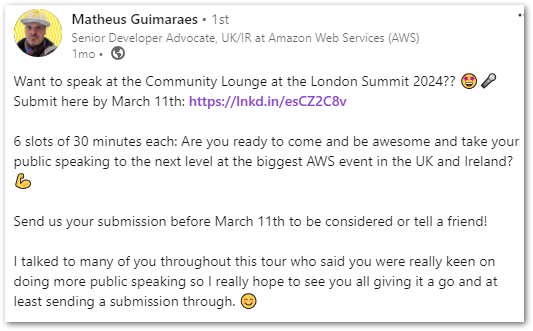
One of my YearCompass 2024 goals was to build a personal brand and focus on my soft skills and visibility. After participating in 2023’s New Stars Of Data 6 event, I wrote some new session abstracts and considered my next move. Then in February I saw Matheus Guimaraes‘ LinkedIn invite to submit sessions for 2024’s AWS Summit London event:

2024 04 09 LinkedInMatheus

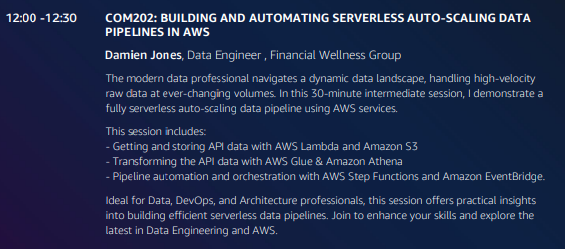
I mulled it over, deciding to submit an abstract using my recent WordPress Data Pipeline project. At the very least, it’d be practice for both writing abstracts and pushing myself to submit them.

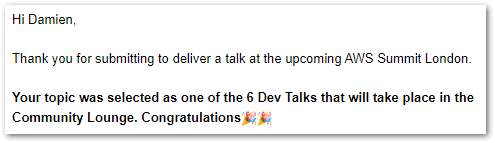
And that’s where I expected it to end. Until…

2024 04 09 GmailAccept

Just like that, I was heading to the capital again! And this time as a speaker!

My AWS Summit London (ASL) experience was going to be different from my New Stars Of Data (NSOD) one in several ways:

  • While NSOD was virtual, ASL would be in person.
  • I had four months to prepare for NSOD, and five weeks for ASL.
  • My NSOD session was 60 minutes, while ASL would be 30.

So I dusted off my NSOD notes, put a plan together and got to work!

Preparation

This section examines the preparation of the slides and demo for my summit session.

Slides

Firstly, I brainstormed what the session should include from my recent posts. Next, I storyboarded what the session’s sections would be. These boiled down to:

  • Defining the problem. I wanted to use an existing framework for this, ultimately choosing the 4Vs Of Big Data. These have been around since the early 2000’s, and are equally valid today for EDA and IOT events, API requests, logging metrics and many other modern technologies.
  • Examining the AWS services comprising the data pipeline, and highlighting features of each service that relate to the 4Vs.
  • Demonstrating the AWS services in a real pipeline and showing further use cases.

This yielded a rough schedule for the session:

  • 00:00-05:00 Introduction
  • 05:00-10:00 Problem Definition
  • 10:00-15:00 Solution Architecture
  • 15:00-20:00 Demo
  • 20:00-25:00 Summary
  • 25:00-30:00 Questions

Creating and editing the slide deck was much simpler with this in place. Each slide now needed to conform with and add value to its section. It became easier to remove bloat and streamline the wordier slides.

Several slides then received visual elements. This made them more audience-friendly and gave me landmarks to orient myself within the deck. I used AWS architecture icons on the solution slides and sharks on the problem slides. Lots of sharks.

Here’s the finished deck. I regret nothing.

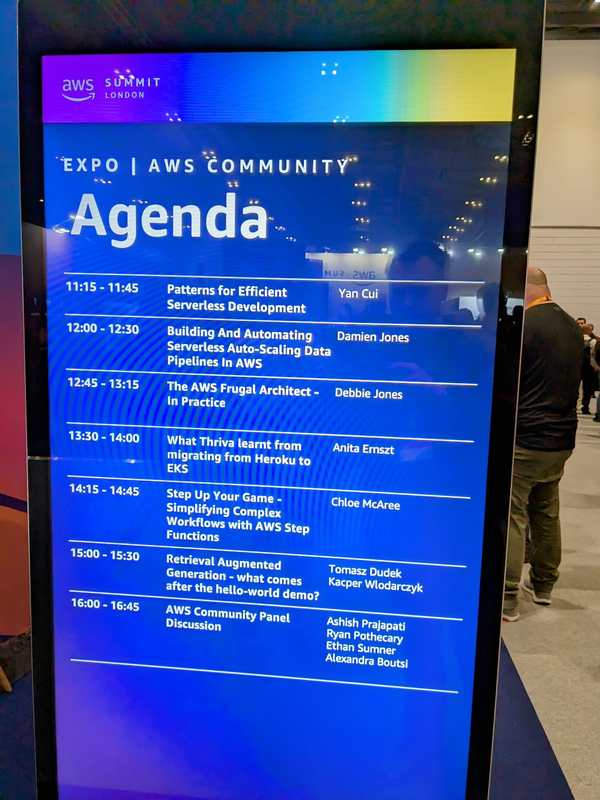
As I was rounding off the slides, the summit agenda was published with the Community Lounge sessions. It was real now!

2024 04 24 AWSSummitSession

Demo

I love demos and was keen to include one for my summit session.

Originally I wanted a live demo, but this needed a good internet connection. It was pointed out to me that an event with thousands of people might not have the best WiFi reception, leading to slow page loads at best and 404s at worst!

So I recorded a screen demo instead. From a technical standpoint, this protected the demo from platform outages, network failures and zero-day bugs. And from a delivery standpoint, a pre-recorded demo let me focus on communicating my message to the audience instead of potentially losing my place, mistyping words and overrunning the allocated demo time.

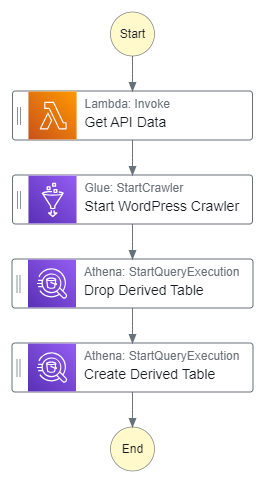
The demo used this workflow, executed by an EventBridge Schedule:

stepfunctions graph

The demo’s first versions involved building the workflow and schedule from scratch. This overran the time allocation and felt unfocused. Later versions began with a partly constructed workflow. This built on the slides and improved the demo’s flow. I was far happier with this version, which was ultimately the one I recorded.

I recorded the demo with OBS Studio – a free open-source video recording and live-streaming app. There’s a lot to OBS, and I found this GuideRealmVideos video helpful in setting up my recording environment:

Delivery

This section covers the rehearsal and delivery of my AWS summit session.

Rehearsal

With everything in place, it was time to practise!

I had less time to practise this compared to NSOD, so I used various strategies to maximise my time. I started by practising sections separately while refining my notes. This gave all sections equal attention and highlighted areas needing work.

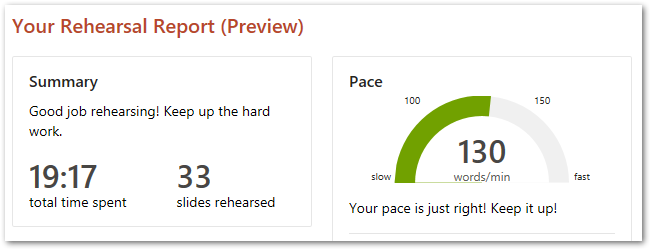
Next, after my success with it last time, I did several full run-throughs using PowerPoint’s Speaker Coach. This went well and gave me confidence in the content and slide count.

2024 04 27 RehersalReportClip

The slide visuals worked so well that I could practise the opening ten minutes without the slides in front of me! This led to run-throughs while shopping, on public transport and even in the queue for the AWS Summit passes.

Probably got some weird looks for that. I still regret nothing.

Practising the demo was more challenging! While the slides were fine as long as I hit certain checkpoints, the demo’s pace was entirely pre-determined. I knew what the demo would do, but keeping in sync with my past self was tricky to master. I was fine as long as I could see my notes and the demo in real-time.

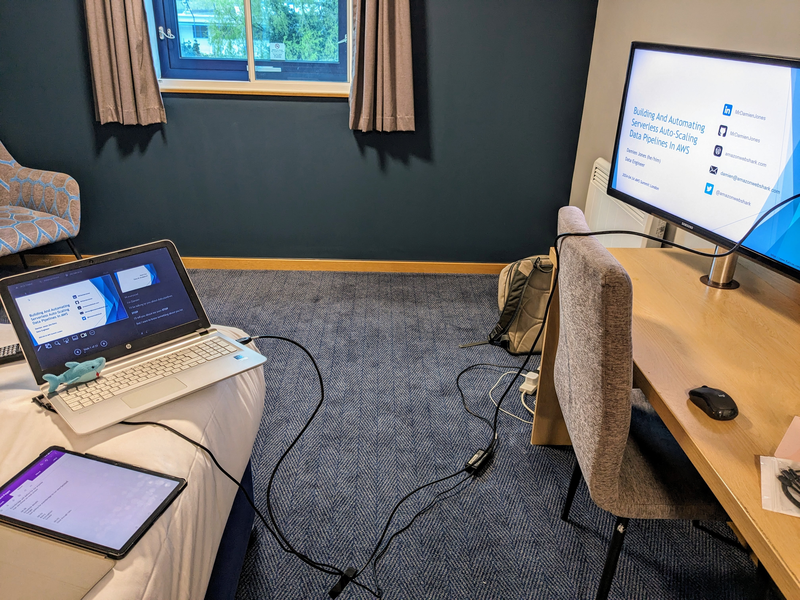
Finally, on the night before I did some last-minute practice runs with the hotel room’s TV:

PXL 20240423 1801344612

On The Day

My day started with being unable to find the ExCel’s entrance! Great. But still better than a 05:15 Manchester train! I got my event pass and hunted for the Community Lounge, only to find my name in lights!

PXL 20240424 1202226372

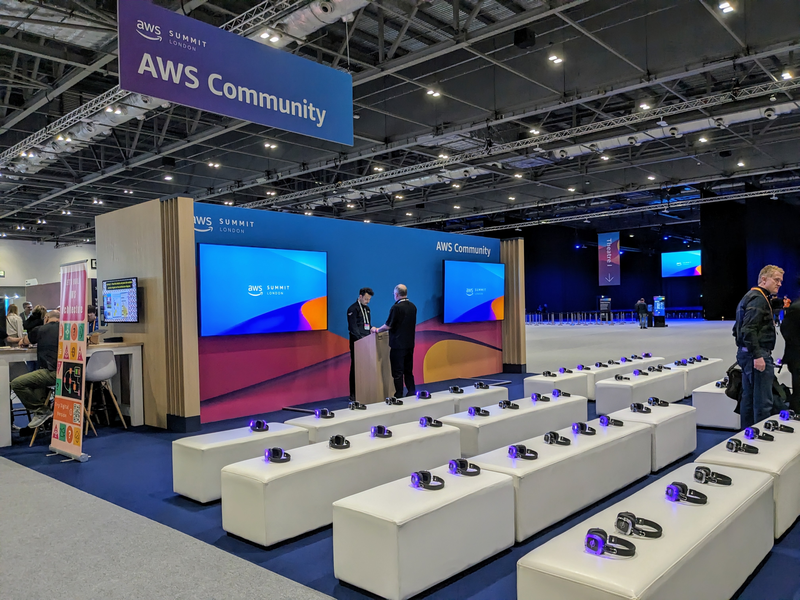
The lounge itself was well situated, away from potentially distracting stands and walkways but still feeling like an important part of the summit.

PXL 20240424 0850558352

I spent some time adjusting to the space and battling my brewing anxiety. Then Matheus and Rebekah Kulidzan appeared and gave me some great and much-appreciated advice and encouragement! Next, I went for a wander with my randomised feel-good playlist that threw out some welcome bangers:

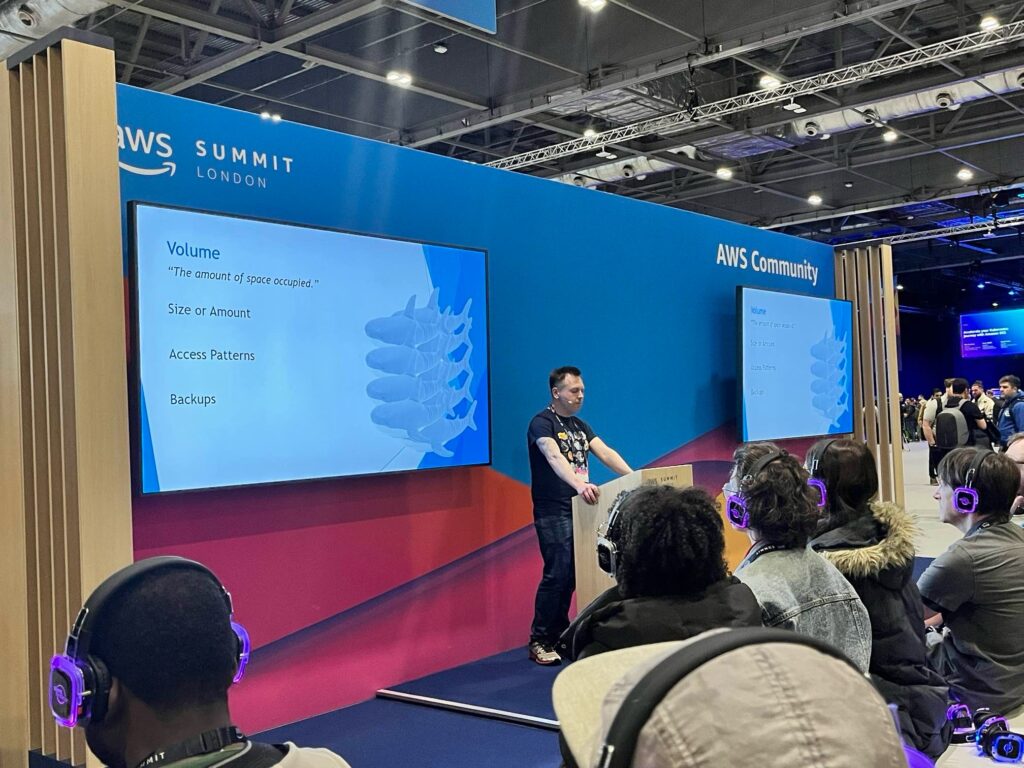
I watched Yan’s session, paying attention to his delivery and mannerisms alongside his session’s content. After he finished I powered on, signed in and miked up. The lounge setup was professional but not intimidating, and the AWS staff were helpful and attentive. Finally, at noon I went live!

IMG 3907
Photo by Thembile Ndlovu

The session went great! I had a good audience, kept my momentum and hit my section timings. I had a demo issue when my attempt to duplicate displays failed. Disaster was averted by playing the demo on the main screens only!

Finally, my half-hour ended and I stepped off the stage to applause, questions and an unexpected hug!

IMG 9401
Photo by Rebekah Kulidzan

Looking Back

So what’s next?

I was happy with the amount of practice I did, and will continue putting time into this in the coming months. I’ve submitted my summit session to other events, and the more rehearsals I complete the higher my overall standard should get.

I also want to find a more reliable way of showing demos without altering Windows display settings. Changing these settings mid-presentation isn’t the robust solution I thought it was, so I want to find a feature or setting that’ll take care of that.

Finally, I plan to act on advice from Laurie Kirk. She suggested speaking about a day’s events on camera and then watching it back the following day. This highlights development areas and will get me used to speaking under observation.

Summary

In this post, I discussed my recent Building And Automating Data Pipelines session presented at 2024’s AWS Summit London.

When writing my post about the 2022 AWS Summit London event, I could never have known I’d find myself on the lineup a few years later! Tech communities do great jobs of driving people forward, and while this is usually seen through a technical lens the same is true for personal skills.

The AWS Community took this apprehensive, socially anxious shark and gave him time, a platform and an audience. These were fantastic gifts that I’m hugely grateful for and will always remember.

PXL 20240424 1606465872

If this post has been useful then the button below has links for contact, socials, projects and sessions:

SharkLinkButton 1

Thanks for reading ~~^~~